Managing strengths and weaknesses to build successful teams
by Mauricio Saul Ramos
In a professional setting, strengths and weaknesses are not always absolute or easy-to-define terms. A team member can be extremely detail-oriented, but he misses or pushes deadlines.
Another person may be extremely introverted and shy, but she is an excellent listener who absorbs all information. Someone else may be highly sociable and outspoken, but they continuously interrupt the client.
It's not about being weak or strong, it’s about matching an individual’s personal characteristics with the requirements of the situation, both at the personal and team level.
There are four widely recognised personality types: Driver, Analytical, Expressive and Aimable.
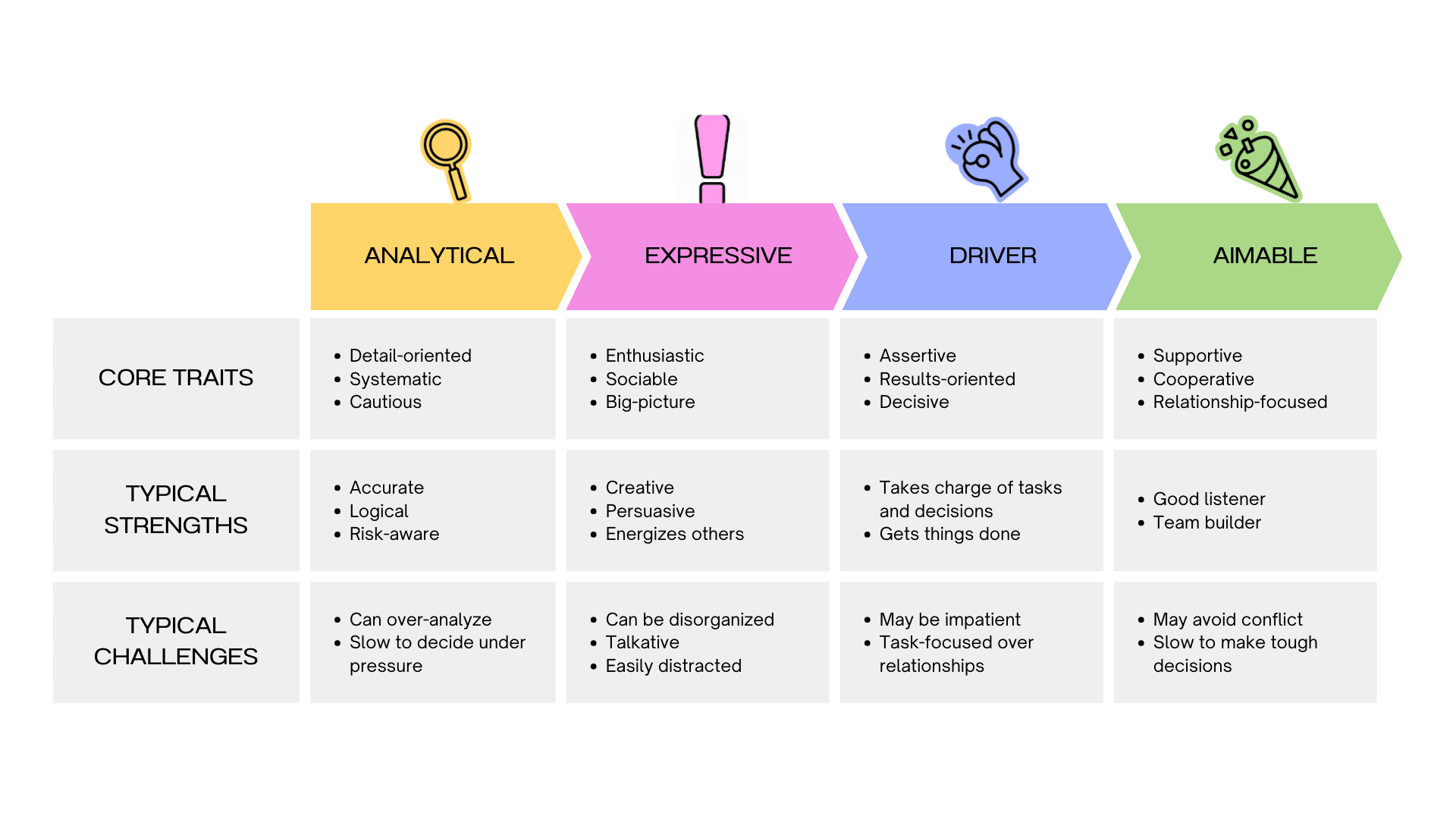
All companies have a combination of these personalities, and most people are not completely one or the other, but a combination of them. There has been extensive research in this area, on what an individual’s characteristics and drivers are, and on how to work with them.
Just as strengths and weaknesses are not absolute but contingent on the situation at hand, the success of a team is not defined by their characteristics, but by how well they solve a particular problem or help a specific client. If the goal is to build successful teams, it is important to keep in mind that clients also have different personalities, and they need to be matched with the teams assigned to them.
From a best practices perspective, this means moving beyond generic team structures. Leaders should consciously consider personality types when assigning roles, structuring interactions, and engaging with clients. A highly analytical team may deliver exceptional accuracy but struggle with urgency; a highly expressive team may build strong relationships but miss critical details. Neither is inherently better or worse; the key is alignment with the task and the client.
In order to achieve the best results in building strong teams, leaders should:
1. Formally assess the personality types of their key members:
- Consider both the technical capabilities and personality types when designing teams;
- Keep the assessment updated.
2. Estimate the personality of the clients:
- Consider the personality of different decision-makers involved;
- Keep in mind the different types of services provided.
3. Balance teams periodically:
- Did the requirements change? Will the team benefit from a member with a different personality?
- Is the team performing well? Can a member be removed to help with another client?
- Are the personalities of client and team still matched correctly?
Ultimately, building successful teams is less about correcting people and more about orchestrating differences. When strengths are leveraged deliberately and weaknesses are anticipated rather than ignored, teams become more resilient, more effective, and better equipped to serve clients consistently.
Mauricio Saul Ramos, consulting director at Guerrero Santana, has more than 15 years of experience advising domestic and international clients on a wide variety of matters. He is also a professor at the undergraduate level teaching courses like Innovation, Project Feasibility, and Strategic Planning.

/https://storage.googleapis.com/ggi-backend-prod/public/media/7273/b47ff612-731b-4957-aac2-f7c5afa8c07c.jpg)
/https://storage.googleapis.com/ggi-backend-prod/public/media/272/imagePJDidk.jpg)
/https://storage.googleapis.com/ggi-backend-prod/public/media/7493/dfe94425-db71-4965-b5a0-0394631f5486.jpg)
/https://storage.googleapis.com/ggi-backend-prod/public/media/7301/042e0cc0-1dd0-4d35-b44f-fd456e2c3c9c.png)
/https://storage.googleapis.com/ggi-backend-prod/public/media/7269/50df1331-2d31-4edf-9d51-5ae0cbe1c013.jpg)
/https://storage.googleapis.com/ggi-backend-prod/public/media/7276/6023a401-2d70-486d-902c-0e2dfbb3e010.jpg)